How Forensic Photonics verifies digital evidence with Content Credentials
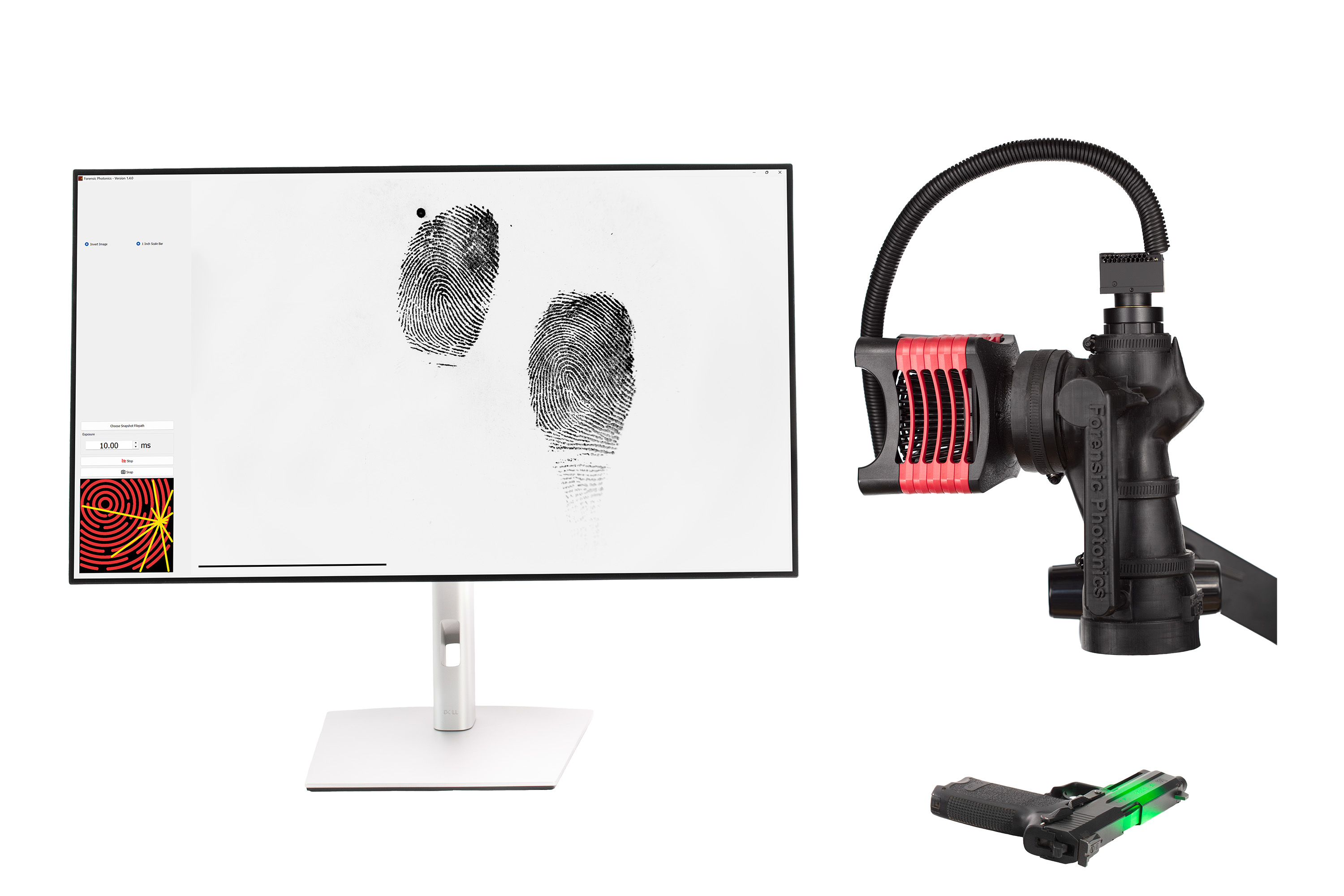
While serving as a juror on three separate criminal trials, Geoff Lambright observed a recurring pattern: Defense attorneys frequently challenged the authenticity of images and other digital evidence to raise doubt about their clients' guilt.
As an imaging specialist with expertise in microscopy, Lambright saw an opportunity to develop more reliable tools for the forensics industry. The company he co-founded, Forensic Photonics, created Latent Imaging Fluorescence Technology (LIFT), a specialized device designed for highly sensitive fingerprint imaging. Law enforcement officers can use LIFT at crime scenes to capture fingerprint images that later serve as evidence in court.
To ensure that attorneys can’t cast doubt on the evidence LIFT produces, Lambright and team decided to embed C2PA signing directly into the device. This enables any attorney, judge, or jury member to instantly verify that imaging evidence is original and unaltered, captured by a specific device on a specific date and time. This innovation not only eliminates doubt but also reduces wasted time and courtroom distractions.
We spoke with Lambright about the evolution of his product and the benefits of C2PA signing in a field where content authenticity is paramount.
This interview has been edited for length and clarity.
Tell me about your background and your inspiration for developing the LIFT device.
I've worked in the imaging field, mostly in microscopy. I was at Zeiss for the bulk of my career, and then I went on to work for a boutique microscopy firm focused on developing neuroscience imaging equipment. As I did that, I became friends with many people in the forensics industry.
I saw how the imaging market was advancing for fields like microscopy, but in forensics, there was a lot less development, and fewer products being brought forward. We saw a big opportunity for a high-performing device using some more current technology, and that is why we developed LIFT.
How is latent fingerprint evidence normally collected, and what problems does LIFT solve?
Historically, there have been about seven different processes. These include liquid dye stains, magnetic powders, chemical processes, and more.
Once you've chosen one of those processes based on the material that the print is on, you're given a set of tools that are typically not very sensitive, are very difficult to use, and require a lot of adjustment and time. The technology for fingerprinting hasn't made a big leap forward in about 50 years, until now.
LIFT uses fluorescence, and is about 1,000 times more sensitive than the next competitor in the market. For image quality, that means that we're capturing a lot more detail and dropping out a lot of the unnecessary background. It isolates the fingerprint itself, and it can replace nearly all of the other techniques that are currently used for processing fingerprints with just one simple method.
Why did you decide to implement C2PA signing in LIFT?
C2PA signing is very valuable for proving the authenticity of the evidence in the courtroom. Imagine that prosecutors are bringing evidence to court, and you have the other side that's trying to tear all of that down by whatever means possible. They can attack digital evidence in a number of different ways.
Today, I don't believe that the chances of a police officer manipulating a fingerprint image is any higher than it was five years ago. People manipulated images then, people manipulate images now. However, defense attorneys are now using AI to develop skepticism among the jury about all digital evidence. This undermines the credibility of latent fingerprint images. It undermines the credibility of any digital crime scene photograph.
From our perspective, being able to integrate C2PA signing into our fingerprint evidence is not only about making sure that the content is authentic, but also about avoiding the unnecessary doubt and skepticism downstream in the courtroom. You can avoid wasting the court's time and the jury's time, and avoid incurring extra legal expenses. You can make the whole court system more robust and effective. I want this to be the industry standard for our field.
Are there any crime scene investigation teams or labs that are currently using your product, or images from it?
We're a small startup, but this isn’t a prototype—it’s available for sale. We do have one system permanently installed in a sheriff's department in Wisconsin, and we have a system set up right now in a crime lab in Orlando. They’re not using the C2PA function yet as a standard part of their protocol, but we’re trying to encourage it.
Did you use any of the Content Authenticity Initiative’s open-source tools? What challenges did you experience in implementation, and do you have any advice for other implementers?
Yes, we did use the CAI’s open-source Python SDK to integrate the C2PA signing workflow into our software, the C2PA Python example code, and the Verify tool to check C2PA signing of the final images in an external tool. While it was easy to get C2PA signing working in a toy example with self-signed certificates stored locally, it was quite challenging to get signing working with a real certificate using a key stored in AWS. The example code had some bugs in it, and the initial documentation was laid out for Mac, so some aspects of the process had to be adapted to a Windows environment. Now at least this is noted in the docs.
Finally, some C2PA signing errors were very generic, so an error getting the AWS key looked like an error in the signer or manifest, which took a while to realize. Overall, my advice would be to keep in mind that C2PA is still a newer technology so the documentation is evolving over time. Also, I’d advise implementers to check very carefully every step of the process when doing signing with a remote key, and to use the CAI Discord server, as there were some helpful folks there for some of our questions.
What are your plans for getting more crime scene investigation teams to adopt this technology?
We’re trying to spread the word. We talk about it at regional, national, and international trade shows. The number one way that we access potential customers is through the International Association of Identification. They have many regional meetings throughout the country. With a device like this, it’s really important that people can get their hands on it and use it directly. They can get a sense of the novel difference that this technology brings to the field.
What I'm seeing from the conversations that I'm having is that people don't quite get it yet. The C2PA signing is a wow factor, but it generally takes a little more explanation. I think the industry understands metadata as a concept, but they don’t realize why C2PA metadata is significant until you mention presenting the evidence in a courtroom.
There’s often the misunderstanding that this technology “locks” an image to disable tampering. Tampering is not actually disabled, but the metadata is tamper-evident, meaning that any changes will be flagged. You’re creating the ability to verify where the image came from and show that it hasn’t been altered. In the courtroom, that’s particularly important because you’re undergoing a lot of scrutiny to prove this. With C2PA, you can be absolutely certain and eliminate unnecessary arguing and distraction.
Geoff Lambright was a guest speaker in our virtual event about authenticity in courtroom evidence. Watch the event in full.