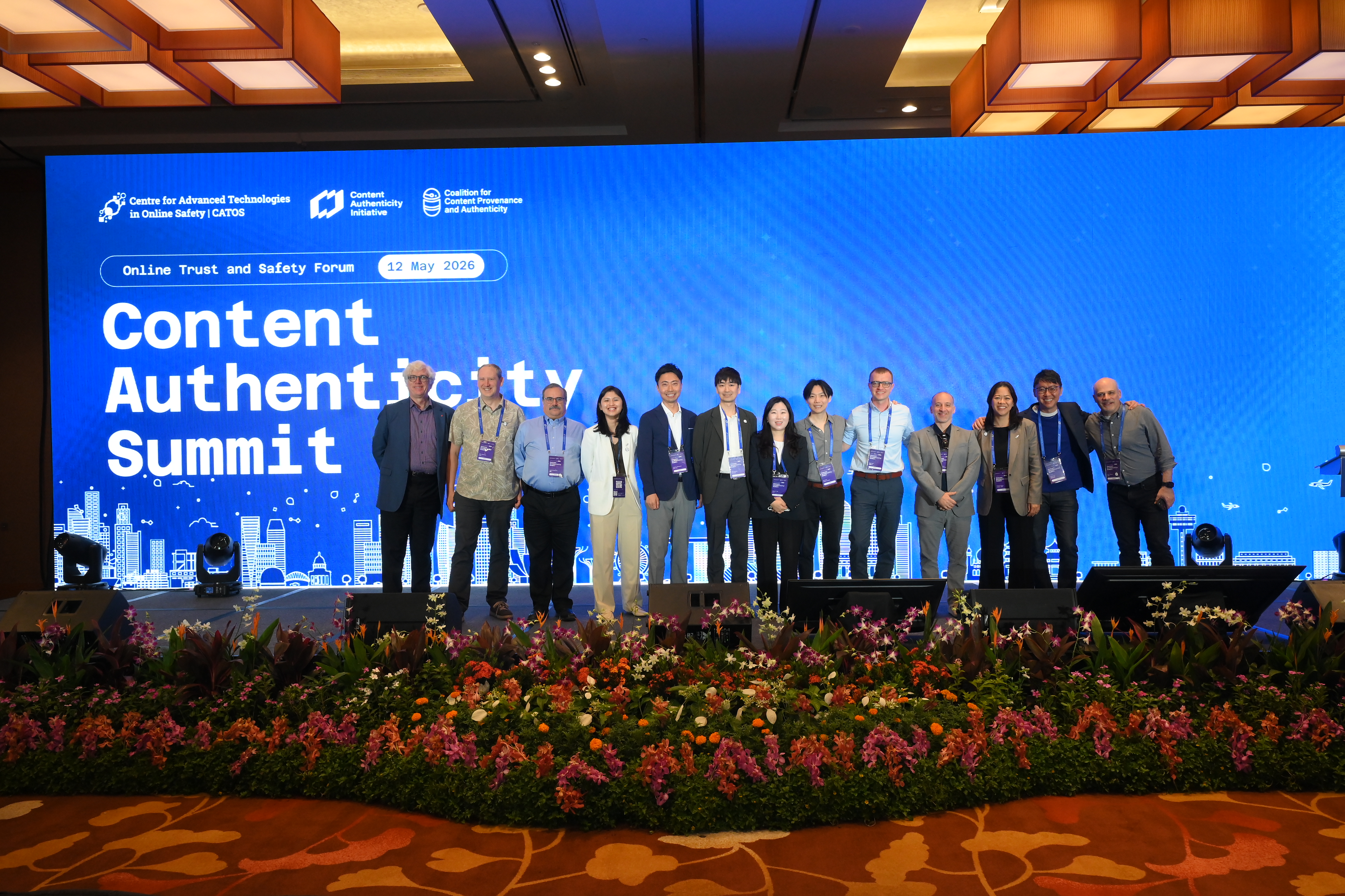
Reflecting on the Singapore Content Authenticity Summit 2026
Nearly 200 policymakers, technologists, media leaders, and platform representatives gathered in Singapore on May 12 to learn about the C2PA standard for digital content provenance. Throughout a full day of keynotes, panel discussions, lightning talks, and hands-on breakout sessions, we focused on a common cause: strengthening digital resilience, transparency, trust, and safety in the age of AI.
Organized by Singapore’s Centre for Advanced Technologies in Online Safety (CATOS), with support from the Adobe-led Content Authenticity Initiative and the Coalition for Content Provenance and Authenticity (C2PA) , it was a milestone event —– the first of its size in APAC — designed to raise awareness and interest in provenance technologies.
From government ministries to generative AI platform developers, from camera manufacturers to academic researchers, the question everyone is asking in this era of AI confusion is no longer whether content authenticity matters. It's how fast can we scale content authenticity to re-establish trust across the wide range of industries for which trust is essential.
Setting the stage: synthetic reality and the infrastructure of trust
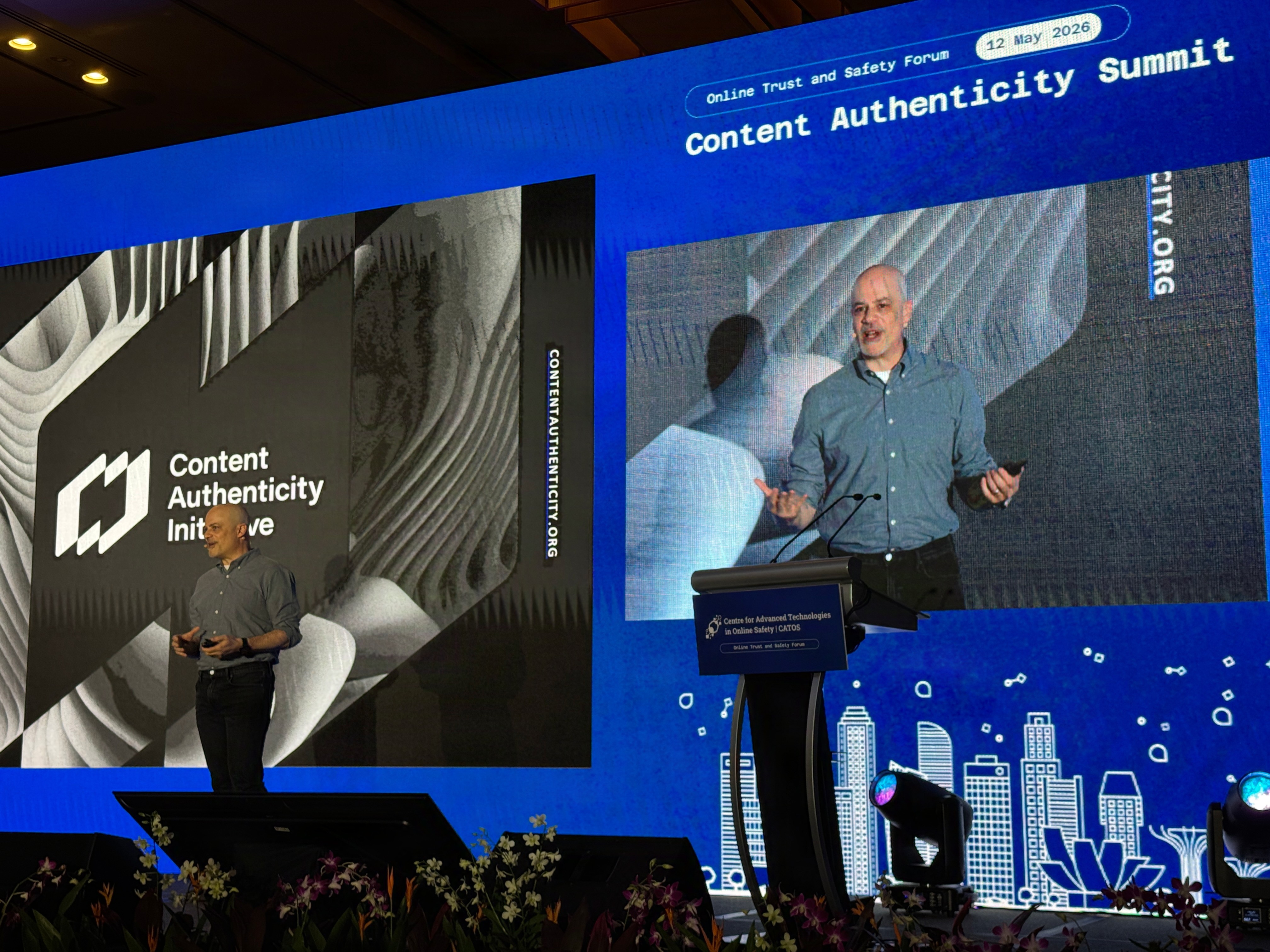
The day opened with Andy Parsons, Adobe’s Global Head of Content Authenticity, tracing the path from synthetic reality to verifiable media. Parsons explored how the infrastructure of trust is being built with proactive transparency and authenticity embedded in digital content from the moment of creation. He examined what early adoption looks like across platforms, the practical challenges that persist, and where further alignment across technology, policy, and user experience remains necessary.
Prof. Emilio Ferrara of the University of Southern California then presented his "Synthetic Reality Stack," a framework for thinking about AI-generated and manipulated content not merely as isolated fakes, but as the product of entire manufactured ecosystems. The real risk, Ferrara argued, is not any single deceptive image or video, but the fabrication of entire "contexts of belief." His four-layer model — Content, Identity, Interaction, and Institutions — offers a map of the attack surfaces where provenance standards must be applied. It is a sobering but essential lens for understanding what we are up against.
Jasmin Lau, Singapore’s Minister-of-State for Digital Development and Information, and Education Minister-in-charge of GovTech, then addressed the gathering. She emphasized the importance of provenance technologies going forward, but she also underscored that Singapore is being conservative with issuing legislation, given the complexities involved.
Trust, transparency, and safety in the AI era: an Asia-Pacific conversation
The day's centerpiece panel brought together voices from government, media, and platforms to examine online trust and content credibility from an Asia-Pacific perspective. In this region, linguistic diversity, platform dynamics, and regulatory environments present distinct challenges and opportunities.
I had the pleasure of moderating the discussion featuring Lee Wan Sie of IMDA Singapore on policy and regulatory dimensions; Willy Tan of Mediacorp on news media perspectives; Norman Ng of Google on platform-level considerations; and Beatrice Yeo of TikTok on safety frameworks and fast-moving misinformation environments.
The conversation surfaced recurring themes: the uneven pace of C2PA adoption across sectors, the tension between platform speed and editorial accountability, and the opportunity for Content Credentials to serve as a common trust infrastructure across very different contexts.
C2PA in practice, from standard to newsroom
Therese Quieta of CATOS and Mediacorp’s Willy Tan then led a plenary session on implementing C2PA in a newsroom setting, using a Mediacorp case study to ground the conversation in the practical realities of day-to-day editorial workflows. This session illustrated a recurring theme of the day: Sstandards matter only insofar as they can be operationalized, and the news media sector is increasingly both an important test bed and eventual standard-bearer.
Tech demo booths showed the ecosystem in action
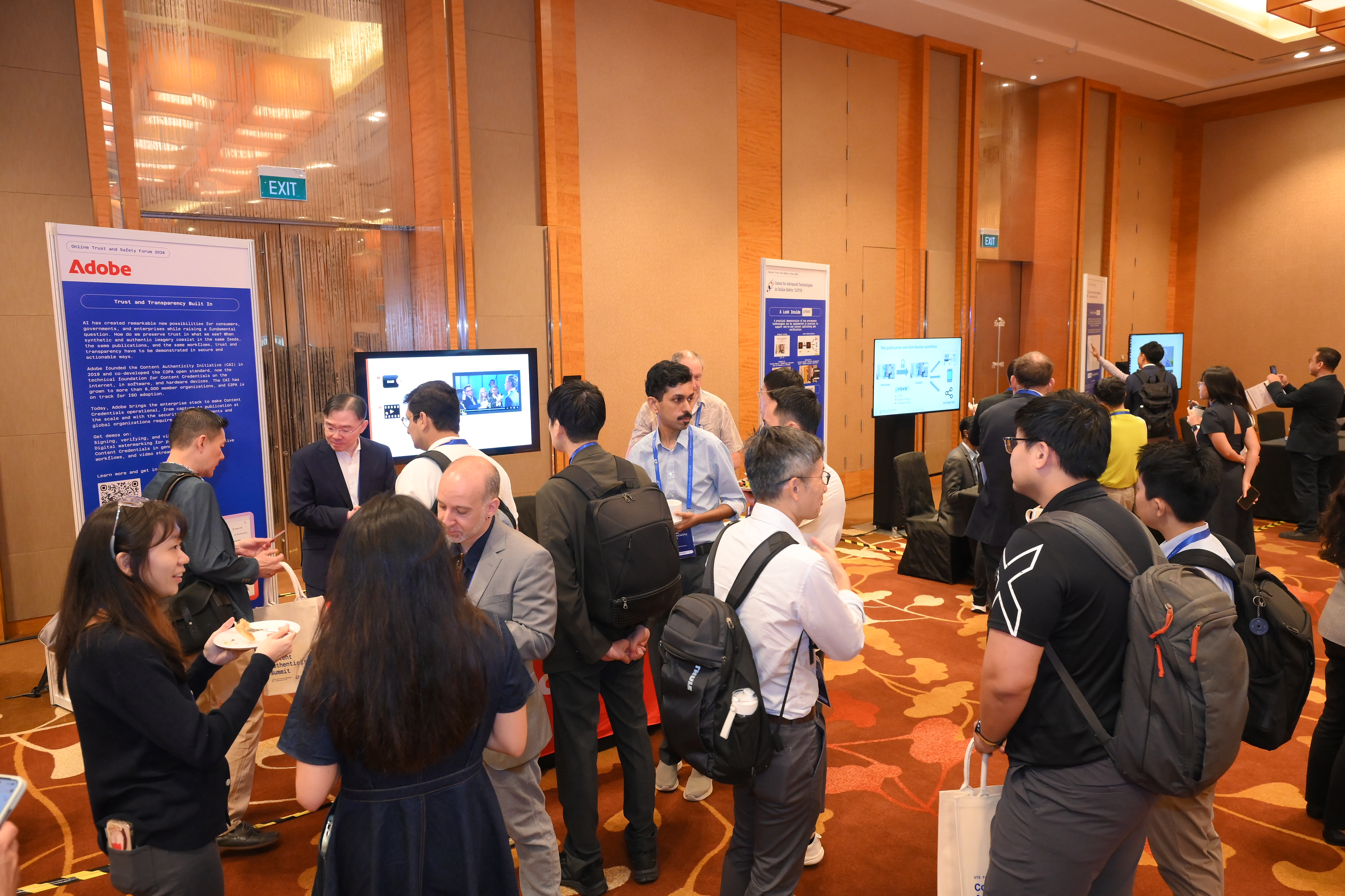
Some of the most energizing elements of the gathering were the tech demo booths, where industry and research participants demonstrated the breadth and maturity of the content authenticity ecosystem. Canon's new line of C2PA-enabled cameras, Adobe's CAI work and Adobe Firefly Services, CODIT, Numbers Protocol, Imatag, and Digimarc all showcased live implementations. CATOS demonstrated Provo, - a newsroom verification workflow tool, - alongside Sleuth Deepfake and AFC V2 detection capabilities. NTU's Academic AI fact-checking game from DeepTech Pillar and the SIT-Academic Critical Thinking Game underscored the growing role of education and media literacy in the broader trust ecosystem.
Lightning talks highlighted the global reach of content provenance
Eight lightning talks crackled through the afternoon, covering the full breadth of places where content provenance is taking root. Attendees got to hear from:
- Bruce MacCormack of IPTC on content provenance implementation in news media
- Leonard Rosenthal of Adobe on the C2PA world of standards
- John Collomosse of the University of Surrey on provenance for content licensing
- Cheryl Lim of CATOS on UX considerations for trust and authenticity labels in Singapore
- Ji Eun Chung of CODIT on policy responses to AI-driven misinformation in South Korea and the wider region
- Bofu Chen on the Numbers Protocol
- Adam Polak of Qualcomm on the role of hardware in content authenticity
- Canon on the critical role of camera capture in the authenticity chain.
Taken together, these talks made clear that content provenance is no longer a single-sector concern. It is simultaneously a hardware question, a policy question, a UX question, and a public interest question — and it is being addressed, in earnest, across all these areas.
Breakout sessions demonstrated where the work gets done
The afternoon breakout sessions were where theory met practice, and where the diversity of the forum participants became most visible and valuable.
Discussions ranged from how newsrooms in APAC can adopt authenticity tools amid multilingual workflows and fast-moving misinformation (session led by Bruce MacCormack of IPTC and Laura Ellis of BBC), to how cultural norms and language diversity shape the design and adoption of provenance signals across the region (session led by Cheryl Lim of CATOS and Prof. Ian McLoughlin of SIT).
A session on policy signals and governance readiness, led by Charissa Soh of Adobe, Ji Eun Chung of CODIT, and Leonard Rosenthal of C2PA, explored how policymakers and platforms are assessing the risks and opportunities of emerging AI governance approaches.
Ian Dejong and John Collomosse of Adobe led a session on emerging use cases and early pilots in APAC, exploring what practical adoption can realistically look like at an organizational scale. And a dedicated session on getting started with C2PA and dDurable Content Credentials —- led by Andy Parsons, Scott Perry, Adam Polak, and Dominique Guinard of Digimarc and SSL.com —- gave practitioners a concrete, technical on-ramp.
Closing on a forward note
The forum closed with a recorded video keynote from Professor Hany Farid of the University of California, Berkeley, one of the world's foremost experts on digital forensics and AI-powered deception. Dr. Farid described an increasingly confusing world where synthetic media in all its forms is becoming indistinguishable from “real” content, accelerating the need to implement both provenance and detection technologies, backed by legislation and public awareness.
What the Singapore summit demonstrated, above all else, is that the content authenticity movement is genuinely global — and that the Asia-Pacific region is an active shaper of it. Governments, platforms, media organizations, academic institutions, and technology developers across the region are not waiting for standards to arrive from elsewhere. They are building, piloting, questioning, and demanding better answers together.
That is exactly the kind of community this work requires. The foundations have been laid. The standards exist. The tools are being built. Now comes the harder but more rewarding work: adoption, at scale, across every language, every platform, and every context where trust in digital content matters.
Which is to say: everywhere.